British primatologist Jane Goodall, who died Wednesday at 91, fostered and wielded vast influence over science and environmental protection across Africa, researchers and conservationists said. She became a global face for issues that would shape the world’s view of the continent for decades.
She was a charismatic advocate for some of Africa’s most charismatic creatures — and some of humankind’s closest cousins. For years, she painstakingly observed chimpanzees in the wild in Tanzania, producing groundbreaking documentation of their tool use, cooperative hunting, complex social structure and individual personalities, before becoming a global storyteller and advocate for conservation.
“She had a lot of patience; she didn’t rush things,” said Paula Kahumbu, a wildlife conservationist, filmmaker and chief executive of WildlifeDirect, a Kenya-based wildlife protection organization founded by Richard Leakey, the son of Goodall’s mentor, Louis Leakey.
Kahumbu, 59, “a product of Goodall’s work, and deeply influenced by her,” said Goodall taught patience through methods that stood in contrast to the more contemporary impetus “to install a camera trap and be out of the forest.”
“She studied animals in the forest, formed relationships with them and patiently recorded her observations over long hours without looking for a quick way out,” Kahumbu said.
Goodall’s research helped lead to the designation of Tanzania’s Gombe National Park; the Jane Goodall Institute runs chimp sanctuaries and supports sustainable conservation jobs in the area and trains young people from around the world in community action.
She was “an unlikely hero with a nontraditional path” who invested in young people around the world and had so many people model their lives after hers, said Rae Wynn-Grant, 39, a U.S. wildlife ecologist and co-host of “Mutual of Omaha’s Wild Kingdom Protecting the Wild,” a wildlife conservation series on NBC.
“I felt less alone knowing that I was living in the age of Jane Goodall,” said Wynn-Grant. Like her, Wynn-Grant said, Goodall “had grown well into her 20s without having any meaningful experience in the wilderness, yet dreamed to spend her life dedicated to saving endangered species from extinction.”
Goodall is the reason many conservational biologists, ecologists and other scientists chose their line of work, said Jessica Deere, 34, a professor in the environmental sciences department at Emory University, who is working with the Gombe Ecosystem Health Project in Tanzania.
“I read her books and fell in love with chimpanzees and wanted to help,” said Deere. “She inspired multiple generations of people across the world; everyone knew how much she cared and that she would never give up.”
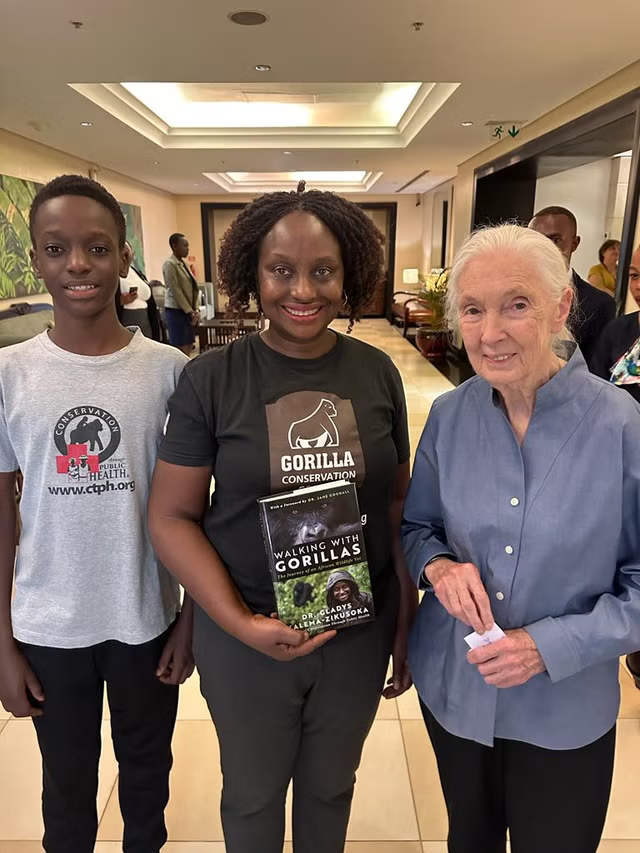
Goodall made conservation accessible to women, especially those for whom such an interest or career was once out of reach. Her message that “everyone can make a difference in conservation” deeply influenced Gladys Kalema-Zikusoka, said the Ugandan veterinarian and founder of Conservation Through Public Health, a Uganda-based organization that promotes biodiversity through conservation. Kalema-Zikusoka, 55, said she was inspired by Goodall after meeting her in London in 1993 and reading one of her books, “In the Shadow of Man.”
“For us who have followed her path to be animal observers, she was just such a leader for us in her approach of observation,” said Kate Detwiler, 53, a professor of biology and anthropology at Florida Atlantic University who studies the evolution and conservation of African forest monkeys. “What she taught us is that the individuals really matter. You can study a species, but what you learn when you observe and describe their behavior individually is really special.”
Annie Olivecrona, 74, a Kenya-based zoologist who rescues trafficked chimpanzees, including from conflict zones such as South Sudan or the Central African Republic, and was friends with Goodall, said she has kept many encouraging letters from Goodall dating back to the 1990s. Olivecrona will continue to be inspired by Goodall’s “all go” and “never give up” spirit, she said.
Toward the end of her life, Goodall reportedly traveled some 300 days a year to spread her message. In her final interviews, said that humankind’s propensity to degrade the planet threw human intelligence into question — but that the human intellect could also provide the path to solutions.
The Jane Goodall Institute carries out programs across Africa, taking what it calls a “community-centered approach” — seeking to align incentives around conservation by linking wildlife protection to human well-being. Its projects include the Tchimpounga Chimpanzee Rehabilitation Center in the Republic of Congo, where more than 200 orphaned, injured or malnourished chimpanzees have lived.
It also supports programs including those helping women become more resilient to climate change in the Democratic Republic of Congo and conserving and managing coastal ecosystems in Kenya and Tanzania. The institute also runs the Gombe Stream Research Center, launched in 1965 to begin observing and researching chimpanzees, including over their entire lifespans.
Among the criticism that Goodall faced in her long career, some centered on her role as a foreign-born face for issues around African wildlife, a mantle local researchers and environmentalists have increasingly assumed.
Kahumbu said the issue is rife with complexities. She expressed “empathy for people who say that foreigners take opportunities from Africans.” But at “the time when Jane came to Gombe, there wasn’t anyone here who could’ve done that work,” Kahumbu said, whereas many local experts, herself included, can now continue it, atop groundwork Goodall laid.
Chimpanzee, gorillas, bonobos, giraffes and elephants in Gombe, the Congo rainforest, Kenya’s Masai Mara and elsewhere are at risk from industry and development, and they need “brilliant, young Africans” to be part of the solution, said Kahumbu.
“We could lose these animals if Africans aren’t involved,” she said, adding that Goodall was always eager to speak to students at local schools and colleges to inspire them to get involved.
“For Jane, it was never about herself or about Africa,” said Kahumbu. “It was always about the chimps.”
Sammy Westfall contributed to this report.


 | By Maham Javaid
No Comments